Fellow Marie-Morgane Rouyer gave a talk entitled Are Marine Protected Areas Well-Placed for the Conservation of Atlantic Migratory Seabirds? on 14 December 2021 at the 30th International Congress for Conservation Biology (ICCB 2021).
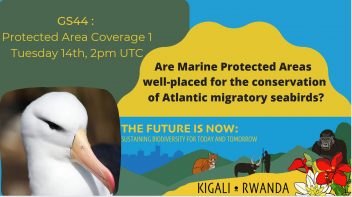

Fellow Marie-Morgane Rouyer gave a talk entitled Are Marine Protected Areas Well-Placed for the Conservation of Atlantic Migratory Seabirds? on 14 December 2021 at the 30th International Congress for Conservation Biology (ICCB 2021).
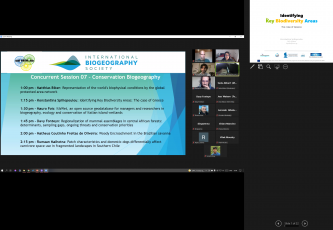
Fellow Konstantina Spiliopoulou gave a talk entitled Identifying Key Biodiversity Areas: The case of Greece on 22 October 2021 at the Early Career Biogeographers Conference.
Continue reading “Presentation: Identifying Key Biodiversity Areas: The case of Greece”
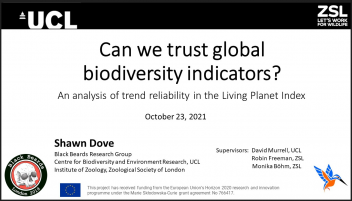
Fellow Shawn Dove gave a talk entitled Can we trust global biodiversity indicators? An analysis of trend reliability in the Living Planet Index on 23 October 2021 at the Early Career Biogeographers Conference, that took place online.

Fellow Marie-Morgane Rouyer co-wrote a paper entitled Tapping into non-English-language science for the conservation of global biodiversity.
The widely held assumption that any important scientific information would be available in English underlies the underuse of non-English-language science across disciplines. In this study, the authors show that non-English-language studies provide crucial evidence for informing global biodiversity conservation and represent nearly a quarter of studies assessing the effectiveness of conservation actions. Non-English-language studies are being published at an increasing rate in 6 out of 12 languages and they can expand both the geographical coverage and the taxonomic coverage of English-language studies. Synthesising non-English-language studies is key to overcoming the widespread lack of local, context-dependent evidence and facilitating evidence-based conservation globally.

Fellow Martin Beal published a paper entitled track2KBA: An R package for identifying important sites for biodiversity from tracking data, co-authored among others by Steffen Oppel, Inês Catry, Paulo Catry and Maria Dias.
They introduce the R package ‘track2KBA’, a tool to identify important sites at the population level using tracking data from individual animals based on three key steps: (a) identifying individual core areas, (b) assessing population-level representativeness of the sample and (c) quantifying spatial overlap among individuals and scaling up to the population. They describe package functionality and exemplify its application using tracking data from three taxa in contrasting environments: a seal, a marine turtle and a migratory land bird. This tool facilitates the delineation of sites of ecological relevance for diverse taxa and provides output useful for assessing their importance to a population or species, as in the Key Biodiversity Area (KBA) Standard. As such, ‘track2KBA’ can contribute directly to conservation planning at global and regional levels.

Fellow Carmen Soria published a paper entitled COMBINE: a coalesced mammal database of intrinsic and extrinsic traits, co-authored by Michela Pacifici, Moreno Di Marco, Sarah M. Stephen and Carlo Rondinini.
Species’ traits are defined as any measurable characteristic belonging to an individual. Traits influence multiple processes such as the distribution of a species, or how species respond to changes in the environment. In this data paper, the authors collected and unified under the same taxonomy, mammal trait data belonging to multiple data sources. COMBINE is a common repository of a variety of mammal traits, including information on morphology, reproduction, diet, biogeography, life-habit and phenology.
Continue reading “New paper: COMBINE: a coalesced mammal database of intrinsic and extrinsic traits”

Once again, Konstantina Spiliopoulou co-wrote a book chapter about Key Biodiversity Areas !
The chapter Implementing and Monitoring Global Biodiversity Targets and Sustainable Development Goals presents how are Key Biodiversity Areas used in Global Biodiversity targets and the Sustainable Development goals, and their future potential. This chapter is published in the book Key Biodiversity Areas, which is the 28th edition of the Nature and Conservation Book Series. In this edition, experts explore different applications or implications of Key Biodiversity Areas in the fight to stop the global loss of biodiversity.

We had planned 4 Supervisory Board Meetings over the entire project, today we had the 8th! This was the 4th ordinary SB meeting, (in addition to 4 extraordinary meetings) and it had been predicted to take place during the summer in Kigali, Rwanda, associated with the International Conference on Conservation Science. Instead, it was again remote. We sure miss meeting in person, but have to recognise that technology allowed us to keep in touch frequently. Very important, in this complicated period.
We discussed how each fellow is doing, now that they are getting progressively close to finishing their projects. Exciting but also stressful times! Also reviewed the 5th and final training session, upcoming deliverables and decided on next steps in the project.

As the end of Inspire4Nature is getting close, we met again for our General Assembly !

Shawn Dove published a new blog post on the Inspire4Nature fellows’ website Science4Wildlife. You can read here his article entitled Is family planning the answer to our climate change and conservation woes?