Project News

20220228_pauline_crop

Farewell to Pauline Roger, our European Project Manager

Today we bid farewell to Pauline Roger as European Project Manager of Inspire4Nature. Pauline joined the project four years ago and her professionalism and dedication have been fundamental to making the project run smoothly.

Pauline came to us with a Master degree in European studies, with specialisation in European policies and programmes, from the University of Aix-Marseille. She cares deeply about biodiversity protection and animal welfare, having done a professional internship in Brussels in an advocacy group for animals, where she worked with European institutions. She is also interested in human sciences and ethology.

Pauline was responsible for coordinating the exchanges within the Consortium and facilitating the consortium’s overall management in conformity with the Grant Agreement and the Consortium Agreement. These responsibilities included a wide set of tasks related to the organisational, administrative, financial and legal management of the project. She also played a major role in the project communication actions.

We wish Pauline all the very best in her future projects!

scottford_article_laos

New paper: Large Differences in Livelihood Responses and Outcomes to Increased Conservation Enforcement in a Protected Area

Fellow Scott Ford co-wrote a paper entitled Large Differences in Livelihood Responses and Outcomes to Increased Conservation Enforcement in a Protected Area.

The authors present a case study from northern Laos to explore how conservation through protected-area enforcement combined with market forces is impacting local livelihoods. The results show a variable response, with some groups able to respond well, while others are more heavily impacted by the imposed restrictions.

Continue reading “New paper: Large Differences in Livelihood Responses and Outcomes to Increased Conservation Enforcement in a Protected Area”

freshwaterFishesMaghreb

Freshwater Fish Distribution in the Maghreb: A Call to Contribute

Fellow Matt Ford published Freshwater Fish Distribution in the Maghreb: A Call to Contribute.

In order to update the IUCN Red List of all freshwater fish species inhabiting the Maghreb region, comprehensive knowledge of their respective geographic ranges is essential. Here we present site-scale distribution records derived from all known sources for native and alien freshwater fish species distributed in Morocco, Algeria and Tunisia. Corrected data compiled from the Global Biodiversity Information Facility plus author contributions and digitised literature data are presented as GIS maps, and the wider scientific and conservation communities are called upon to help fill knowledge gaps and maximise the value of this new database for a region in which freshwater biodiversity is undergoing a serious decline.

Continue reading “Freshwater Fish Distribution in the Maghreb: A Call to Contribute”

lumbierres13851-fig-0001-m

New paper: Translating habitat class to land cover to map area of habitat of terrestrial vertebrates

Fellow Maria Lumbierres with fellow Prabhat Raj Dahal published a paper entitled Translating habitat class to land cover to map area of habitat of terrestrial vertebrates, co-authored by Moreno di Marco, Stuart H. M. Butchart, Paul F. Donald and Carlo Rondinini.

They developed a data-driven method to translate IUCN Red List Habitat classes to ESA CCI and Copernicus land covers based on point localities of almost 7000 terrestrial vertebrates. The model provided greater standardization, objectivity, repeatability and allowed uncertainty to be quantified when mapping Area of Habitat.

Continue reading “New paper: Translating habitat class to land cover to map area of habitat of terrestrial vertebrates”

cobi13756-fig-0002-m

New paper: Testing a global standard for quantifying species recovery and assessing conservation impact

Fellow Matt Ford and senior scientist Tom Brooks were co-authors in a paper entitled Testing a global standard for quantifying species recovery and assessing conservation impact, let by Molly Grace.

Grace, M.K., Akçakaya; H.R., Bennett, E.L., Brooks, T.M., et al (Ford, M.) (2021) Testing a global standard for quantifying species recovery and assessing conservation impact. Conservation Biology. https://doi.org/10.1111/cobi.13756Open Access Repository Continue reading “New paper: Testing a global standard for quantifying species recovery and assessing conservation impact”

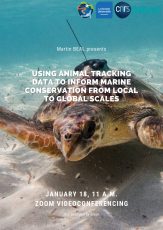
mbealChize

Presentation: Using animal tracking data to inform marine conservation from local to global scales

Fellow Martin Beal presented his work by giving a videoconference entitled Using animal tracking data to inform marine conservation from local to global scales for the Centre d’études biologiques de Chizé (CEBC) on 18 January 2022.

Continue reading “Presentation: Using animal tracking data to inform marine conservation from local to global scales”

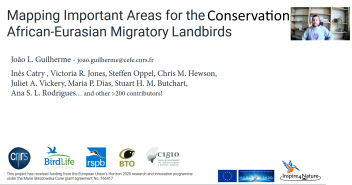
ICCB_JLGuilherme

Presentation: Identifying Important Areas for the Conservation of African-Eurasian Migratory Landbirds Using Tracking Data

Fellow João L. Guilherme gave a talk entitled Identifying Important Areas for the Conservation of African-Eurasian Migratory Landbirds Using Tracking Data on 16 December 2021 at the 30th International Congress for Conservation Biology (ICCB 2021).

Continue reading “Presentation: Identifying Important Areas for the Conservation of African-Eurasian Migratory Landbirds Using Tracking Data”

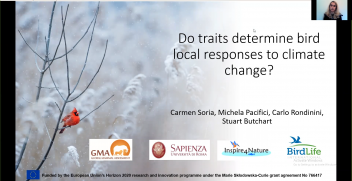
carmeniccb2021

Presentation: Do traits determine bird local responses to climate change?

Fellow Carmen Soria gave a talk entitled Do traits determine bird local responses to climate change? on 14 December 2021 at the 30th International Congress for Conservation Biology (ICCB 2021).

Continue reading “Presentation: Do traits determine bird local responses to climate change?”

LUMBIERRESICCB

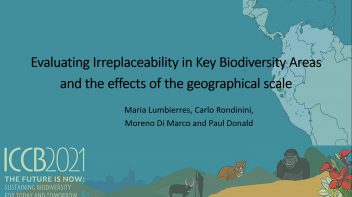
Presentation: Evaluating Irreplaceability in Key Biodiversity Areas and the effects of the geographical scale

Fellow Maria Lumbierres gave a talk entitled Evaluating Irreplaceability in Key Biodiversity Areas and the effects of the geographical scale on 14 December 2021 at the 30th International Congress for Conservation Biology (ICCB 2021).

Continue reading “Presentation: Evaluating Irreplaceability in Key Biodiversity Areas and the effects of the geographical scale”